Gilded-Mongoose
Gilded-Mongoose t1_j8lz4wd wrote
Reply to comment by RockstarAgent in Physicists Say Aliens May Be Using Black Holes as Quantum Computers : ScienceAlert by Gari_305
Dammit that’s what I meant. Please don’t think of me as being as wholesome to have naught but flashlights on my mind. I beg thee.
Gilded-Mongoose t1_j8lwj0q wrote
Reply to comment by HarlanCulpepper in Physicists Say Aliens May Be Using Black Holes as Quantum Computers : ScienceAlert by Gari_305
They “might” be using them as an inter dimensional flashlight too.
Gilded-Mongoose t1_j7991gm wrote
The Space Slushies when we get to Mars are going to be out of this world
Gilded-Mongoose t1_j6c1ett wrote
2003 - 2013 was breakthrough / proliferate into mainstream era 2013 - 2023 was fine tune era and developing less visibly or universally applied improvements.
Gilded-Mongoose t1_j62en8o wrote
Reply to If given the chance in your life time, will join a theoretical transhumanist hive mind? by YobaiYamete
Nope. No San Junipero for me. I’m good.
Maybe a brief glimpse but I’m largely good.
Gilded-Mongoose t1_j3klba6 wrote
That’s because we haven’t had true AI yet. Just new software learning and production techniques that we’re calling AIA and getting all hyped over ourselves over. I’m still sleep on it.
Wake me up when it can replicate and codify genetic code, isolate specific traits and features, and transpose it into programming features or create new versions of life.
Gilded-Mongoose t1_j3h75w6 wrote
Reply to comment by MeaningfulThoughts in New Study Uncovers Potential Target for Stopping 90% of Cancer Deaths by Shelfrock77
Username’s not checking out bro :-/
Gilded-Mongoose t1_j1r40b6 wrote
Reply to comment by Arrasor in Does the brain have extreme potential by frameworkgenerous
Right. And like…pleasure. It’s a series of chemicals sent to our brain telling us that it’s “good” - but how the hell do we actually process and experience it as such!? Both that and things like itches. What is it that makes that difference between understanding something as a signal of “yes this is a good thing” or “an itch” vs actually experiencing the thing and knowing what to do?
I WISH I could simply experience pain or discomfort on an objective level, like a car light going on - but something about it is just too subjective. What is that “thing” on a biological / neurological level beyond the base mechanisms?
Gilded-Mongoose t1_j1qs1ty wrote
Reply to Is there any real upper limit of technology? by basafish
I don’t think so. Every new step is a plateau.
I really think anti-matter or dark matter & discovering how to understand, and actually control or manipulate, the force of gravity are going to be HUGE difference makers.
True (not Hollywood or pedestrian) artificial intelligence and being able to truly create and design life will be similar game changers. Figuring out a concept of non-carbon based life will also be equally groundbreaking.
And finally the ability to continue the concept of “invisibility” fascinates me. I was deep in Popular Mechanics a long time ago and they were talking about the concept of invisibility - bending light waves around an object. It went from bending radio waves (ie radar invisibility), up to light waves (visual invisibility), and started talking about actual physical bending of things. Basically enabling physical things to not collide with each other. It was highly highly theoretical (like barely scientifically theoretical), but conceptually it makes you wonder how things will be 100 years from now, never mind 500 or another thousand.
Gilded-Mongoose t1_j1ozvju wrote
Reply to Is it possible to Live Forever? by gg2ezpzlemonsqz
Y’all don’t realize memory transfer doesn’t mean “you” live forever. You’re not transferring yourself - it’s just another exact clone of you.
I’ve said this before - you can duplicate your memory elsewhere but just imagine you don’t die - you’re still watching your “other” self run amok but if you die then you still die.
Gilded-Mongoose t1_iybjil6 wrote
Reply to comment by JumpOutWithMe in Seemingly Impossible: Nanostructure Compresses Light 10,000 Times Thinner Than a Human Hair by Shelfrock77
Thanks JOWM
Gilded-Mongoose t1_iyb9sg6 wrote
Reply to comment by blueSGL in Seemingly Impossible: Nanostructure Compresses Light 10,000 Times Thinner Than a Human Hair by Shelfrock77
SOTA?
Gilded-Mongoose t1_ixesa4w wrote
Reply to Neuralink Co-Founder Unveils Rival Company That Won't Force Patients To Drill Holes in Their Skull by Economy_Variation365
These are all just commercialized cochlear implants for hearing people.
Gilded-Mongoose t1_it6fg6j wrote
Reply to comment by ouaisouais2_2 in Why do companies develop AI when they know the consequences could be disastrous? by ouaisouais2_2
I think the alarms are both dramatic enough and are enough false alarms/alarmist that we dismiss them.
If anything it could bring about the 5th Industrial Revolution in ways that we haven’t seen before. And just as the 1st through ongoing-4th ones have been, we’ve gone along for the ride. As a species we are very, very adaptable and flexible. And singularity on its own - software, calculations, non-living incentives (most of our social malice stems from our biological mortality, which would have to be artificially programmed, and which would be weeded out by the majority of purely logical directives) - isn’t very much of a threat. It opens up far, far more progressive opportunities than threats. Far more than society’s collective creativity is even aware of yet - see how over in AI, all they’re doing is creating porn, psychedelic videos, and just generally weird or stupid concepts.
Even the scientific community is really only using it as a shortcut processing tool.
So yeah. Real life is often boring and I think that, realistically, we’re expecting relatively more of the same in that regard.
Gilded-Mongoose t1_it65r1w wrote
Reply to comment by ouaisouais2_2 in Why do companies develop AI when they know the consequences could be disastrous? by ouaisouais2_2
To see instances of progression not sound the alarms or Hollywood plot our way through the days.
Gilded-Mongoose t1_it5gkuk wrote
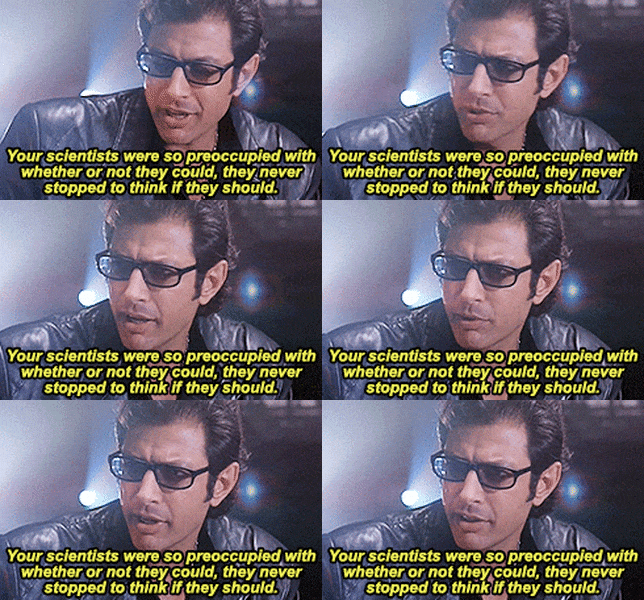
Gilded-Mongoose t1_iswexsy wrote
Reply to comment by jpj007 in How do you think every person born in 2002 to 2014 will be in the end of 2029? How do you think every person born in January 1, 2002 to December 31, 2014 will be in the end of 2029? These people will be 15-27 in the end of 2029! by genrationer
I’m watching The Grand Budapest Hotel right now and really soaking in the distinctive Wes Anderson’s style of technically crisp and adamantly quirky in execution.
This question simply smacks of the same energy.
Gilded-Mongoose t1_irjashz wrote
Perfect Watchmen/Dr. Manhattan plot, innit?
Gilded-Mongoose t1_ircd2xm wrote
Reply to comment by NarcissistSlayer in Groundbreaking Research Exposes Immune System’s “Off Button” by Shelfrock77
r/unexpectedlywholesome
Gilded-Mongoose t1_ircd1wi wrote
Reply to comment by Amazing-Bit6140 in Groundbreaking Research Exposes Immune System’s “Off Button” by Shelfrock77
Got in right in the nick of time.
Gilded-Mongoose t1_j9md754 wrote
Reply to What. The. ***k. [less than 1B parameter model outperforms GPT 3.5 in science multiple choice questions] by Destiny_Knight
This guy AI’s